Foregut surgery and GERD
Personalized treatment for acid reflux, hiatal hernias, and disorders of the esophagus and stomach.
Frequent heartburn, food coming back up, difficulty swallowing, or waking at night coughing can interfere with eating, sleeping, and everyday life. You may have tried medications for years, or been told you have a hiatal hernia without understanding what it means.
Treatment begins with finding the cause.
Dr. Samakar provides comprehensive evaluation and treatment for gastroesophageal reflux disease (GERD), hiatal and paraesophageal hernias, achalasia, and other disorders of the esophagus and stomach. Care begins with identifying the cause of your symptoms and understanding your goals.
Treatment may include medication, endoscopic therapy, or minimally invasive surgery, performed laparoscopically, or robotically when it offers a benefit. The right approach depends on you, not on the technology.
What is GERD?
Gastroesophageal reflux occurs when stomach contents flow backward into the esophagus, the tube that carries food from your mouth to your stomach. The lower esophageal sphincter and the surrounding diaphragm normally work together as a barrier against reflux. When this barrier does not function properly, acid and other stomach contents can travel upward.
Occasional reflux is common. GERD is reflux that causes repeated, troublesome symptoms or complications. It can affect your comfort, sleep, food choices, and quality of life.
Common symptoms of acid reflux
GERD can cause more than heartburn. Symptoms may include:
A burning sensation behind the breastbone, often after meals or when lying down.
Food or liquid coming back into the throat or mouth, sometimes with a sour or bitter taste.
Symptoms that interrupt sleep or cause waking with coughing or choking.
Food feeling slow to pass or becoming stuck.
Pain or pressure that can sometimes resemble other medical conditions.
Some patients also experience persistent cough, hoarseness, throat clearing, or asthma-like symptoms, sometimes described as “silent reflux” or laryngopharyngeal reflux (LPR). Because throat and breathing symptoms have many possible causes, careful evaluation helps determine whether reflux is contributing and whether reflux treatment is likely to help.
Can longstanding GERD damage the esophagus?
Repeated exposure to stomach contents can injure the lining of the esophagus. The severity of heartburn alone does not reliably show whether damage is present.
- Esophagitis: inflammation that may cause irritation, pain, erosions, or ulcers
- Esophageal stricture: scar-related narrowing that makes swallowing difficult
- Bleeding: injury to the lining can occasionally cause bleeding or anemia
- Barrett’s esophagus: a change in the esophageal lining associated with an increased risk of esophageal adenocarcinoma
Barrett’s esophagus treatment and surveillance
Barrett’s esophagus is not cancer, and most people with Barrett’s do not develop cancer. It does, however, require an individualized plan for treatment and monitoring. Upper endoscopy with biopsies helps identify Barrett’s and whether abnormal cells, called dysplasia, are present. Depending on the findings, care may include acid suppression, surveillance endoscopy, or endoscopic treatment to remove or destroy abnormal tissue.
Anti-reflux surgery may be appropriate for reflux control in selected patients with Barrett’s, but it does not eliminate the need for recommended surveillance, and it is not a proven way to prevent esophageal cancer.
Hiatal and paraesophageal hernias
What is a hiatal hernia?
A hiatal hernia occurs when part of the stomach moves through the opening in the diaphragm where the esophagus enters the abdomen.
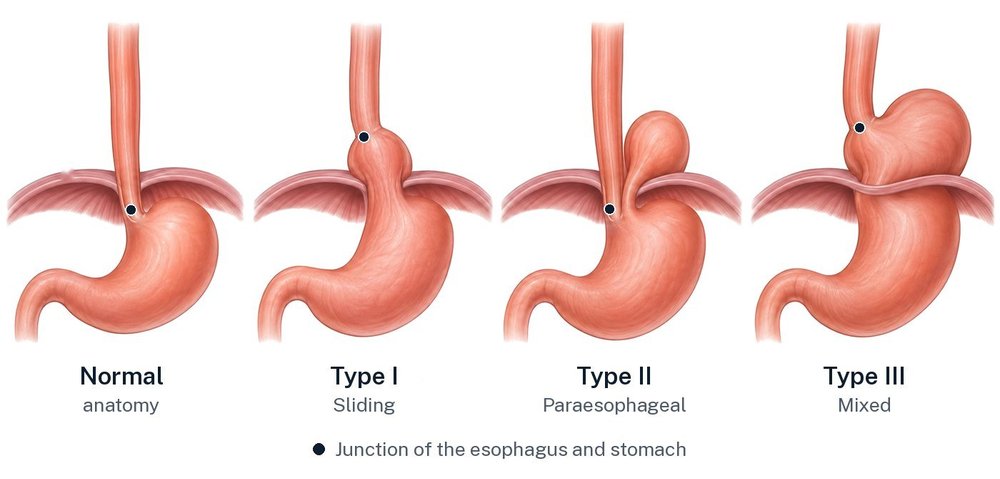
The most common type is a sliding hiatal hernia, in which the junction between the esophagus and stomach moves above the diaphragm. This can weaken the natural reflux barrier and contribute to GERD.
A hiatal hernia and GERD are related, but they are different conditions. Some people have a hiatal hernia without significant reflux, while others have GERD without a hernia.
What is a paraesophageal hernia?
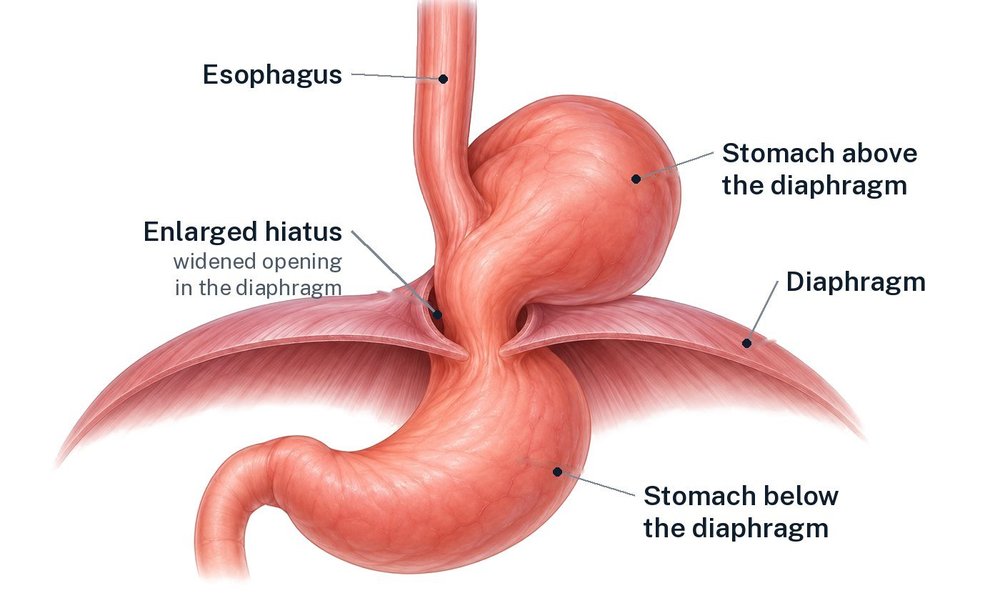
A paraesophageal hernia is a less common type of hiatal hernia in which part of the stomach moves into the chest alongside the esophagus. Larger hernias may involve much of the stomach and, occasionally, other abdominal organs.
Symptoms can include feeling full after small meals, pressure or pain after eating, difficulty swallowing, regurgitation, shortness of breath, or anemia from chronic blood loss. In some cases, the stomach can twist or become obstructed, creating an urgent problem.
Treatment depends on symptoms, anatomy, overall health, and surgical risk. Some patients benefit from repair; others may be appropriately managed with observation and follow-up.
Reflux, hernias, and aspiration in older adults
Hiatal hernias become more common with age, and some enlarge over time. Older adults may experience less obvious heartburn while developing difficulty eating, anemia, breathing symptoms, or regurgitation.
Refluxed material can sometimes enter the airways, called aspiration, contributing to cough, lung irritation, or pneumonia. These symptoms deserve evaluation, particularly when they occur at night or alongside a large hernia.
Age alone does not determine whether surgery is appropriate. We consider symptoms, frailty, heart and lung health, nutritional status, and each patient’s priorities when weighing treatment options.
GERD testing: finding the cause before choosing treatment
A successful treatment plan starts with an accurate diagnosis. Testing is tailored to your symptoms and may include:
Examines the esophagus and stomach for inflammation, narrowing, Barrett’s esophagus, and other abnormalities.
Wireless pH testing (often called Bravo) or catheter-based pH-impedance testing measures reflux over time. Impedance testing can also detect non-acid reflux.
Measures swallowing coordination and muscle function, helps identify conditions such as achalasia, and guides procedure selection.
An X-ray swallowing study that evaluates anatomy, hernias, narrowing, and how contrast moves through the esophagus.
Such as a gastric emptying study, when delayed stomach emptying may be contributing.
Not everyone needs every test. Before an anti-reflux procedure, the goal is to confirm the diagnosis and understand both anatomy and swallowing function.
GERD treatment options
Lifestyle changes and medication
Many patients improve with an individualized combination of meal timing, avoiding personal triggers, elevating the head of the bed for nighttime symptoms, weight management when appropriate, and medication.
Proton pump inhibitors (PPIs) reduce stomach acid and help heal acid-related inflammation. They do not repair a hiatal hernia, and some patients continue to experience regurgitation despite improved acid control. Persistent symptoms deserve reassessment before escalating treatment.
When should you consider anti-reflux surgery?
A surgical consultation may be helpful if you have confirmed GERD with persistent symptoms despite appropriate treatment, significant regurgitation, a symptomatic hernia, medication intolerance, or a preference to discuss alternatives to ongoing medication.
Not responding to heartburn medication does not automatically mean you need surgery. Testing may identify reflux, a swallowing disorder, or another explanation for your symptoms.
Minimally invasive surgery
Many foregut operations can be performed through small incisions, laparoscopically or, when it offers a benefit, robotically. When a hernia is present, repair generally involves returning the stomach to the abdomen and repairing the opening in the diaphragm. An anti-reflux procedure may be performed at the same time.
Procedures for reflux, hernias, and swallowing disorders
Fundoplication: complete and partial wraps
Fundoplication wraps the upper portion of the stomach around the lower esophagus to reinforce the valve between them, helping restore the barrier that keeps acid and stomach contents from flowing back up.
A wrap can be complete, going all the way around the esophagus (360 degrees), or partial, going part of the way around. A complete wrap creates a strong barrier. A partial wrap still controls reflux well for most patients and may cause less difficulty swallowing and less gas and bloating.
The choice depends on your anatomy, swallowing function, symptoms, and preferences. We discuss the balance between reflux control and potential effects such as bloating or difficulty swallowing.
Magnetic sphincter augmentation (LINX)
A small ring of magnetic beads is placed around the lower esophagus to reinforce the reflux barrier. The beads separate when you swallow so food can pass.
It may be an option for some patients after testing confirms GERD and checks swallowing function. We review the possible downsides with you, including difficulty swallowing and limits on future MRI scans.
Endoscopic anti-reflux therapies
Some patients may be candidates for a procedure that rebuilds the anti-reflux valve using instruments passed through the mouth, without incisions (transoral incisionless fundoplication, or TIF). When a hiatal hernia is present, it may be combined with laparoscopic hernia repair (cTIF).
These procedures suit only certain patients. Dr. Samakar does not perform TIF, but he can help you decide whether an endoscopic approach, surgery, or another option fits best, and refer you when appropriate.
Redo anti-reflux surgery and recurrent hiatal hernias
Symptoms can return after a previous fundoplication or hernia repair. Possible causes include a recurrent hernia, changes in the wrap, narrowing, or a separate swallowing disorder.
We evaluate the reason for recurrent symptoms before recommending another operation. Treatment may involve repairing the hernia, revising the wrap, or, for some patients, conversion to gastric bypass, particularly when obesity is also a factor.
Reflux after a sleeve gastrectomy? See revisional bariatric surgery →Achalasia and difficulty swallowing
Achalasia is a swallowing disorder in which the lower esophageal sphincter does not relax normally and the esophagus loses its normal coordinated movement. It can cause difficulty swallowing both solids and liquids, regurgitation, chest discomfort, and weight loss, and it is sometimes mistaken for GERD.
Dr. Samakar performs Heller myotomy, usually combined with a partial fundoplication. Other treatment options include peroral endoscopic myotomy (POEM) and pneumatic dilation; the right choice depends on the type of achalasia, overall health, and treatment goals. These treatments improve the passage of food but do not restore normal esophageal muscle function.
Recovery after foregut surgery
Some patients can go home the same day after selected minimally invasive procedures. Others need an overnight stay or longer monitoring, particularly after complex hernia repair or revisional surgery.
Recovery depends on the operation and your overall health. Your care plan includes specific guidance on eating, activity, symptom management, and follow-up. After many foregut procedures, food consistency is advanced gradually while swelling resolves.
Frequently asked questions
Can GERD cause coughing without heartburn?
Yes, reflux can contribute to cough without typical heartburn. Because cough has many causes, evaluation is important before attributing it to GERD or recommending surgery.
Does every hiatal hernia need surgery?
No. Treatment depends on the hernia type, symptoms, complications, and overall health. Some can be monitored; others benefit from repair.
Will I still need reflux medication after surgery?
Many patients reduce their medication use after successful treatment, but some continue or restart medication. Results vary, and no procedure guarantees lifelong freedom from reflux.
Is GERD surgery permanent?
Anti-reflux procedures are intended to provide lasting benefit, but symptoms or hernias can recur. Follow-up helps identify and address problems if they develop.
I live far from Los Angeles. Can I still be seen?
Yes. Dr. Samakar holds a weekly telemedicine clinic, so many visits before and after surgery can happen from home.
Take the next step.
Whether you are dealing with persistent heartburn, a large hiatal hernia, difficulty swallowing, or symptoms after previous surgery, Dr. Samakar can help you understand your options. Call to schedule a consultation in Los Angeles, Glendale or Pasadena, or by telemedicine.